NM4210 User Experience Design

Friday, April 25, 2008

Lessons Learnt

After taking NM4210, designing has become a more experiential task for me., showing me the need to feel as a user using the product rather than just focusing on the exterior, as I am a more visual person.

The main gist is in designing experiences and not concentrating on solely the designing of the product only where human interactions takes a heavy weightage. From the different assignments that thought us to recognise a good and bad design, to differentiating between visceral, behavorial and reflective design, then to pleasure analysis with the creation of user persona, to working on a design probe through examination by different user study methods and finally the final project which took out nearly half of my life, working through the night to come up with suitable graphical designs(the first 2 design came out as a failure thou), this module taught and equip us with appropriate and necessary tools that can assist us in evaluating user experience to a certain extent.

I do not put it down as absolute here as this module also came to me as a very subjective. Quoting what Mr Reddy has said during one of the lecture, he reminded us that there is not a definite yes and no answer in User Experience Analysis. Things are still debatable and there is not yet a standard definition for a good UX design. And with practices, I believe UX design will come more as a breeze when we develop on our "common sense" to come up with suitable design for specific target audience. In a nutshell, user experience design is a very "human" topic which makes use subjectivity in its evaluation, thus one needs to be observant to excel in this area and even if one do not plan to expand in this field, I truly think it help us become more sensitive to the needs of others.

Tuesday, April 22, 2008

Reflections on User Research Smoke & Mirrors

Originally, design came as a very intuitive thing to me, something that is based on one's imagination and portrait of what he or she wants to design. As long as the design looks cool (mainly to me only), captures the correct attention and the colour scheme fits the theme, that will occur to me as a good design. But after taking the module and reading Fahey's article "User Research Smoke & Mirrors", things have been taken to a whole new dimension. Design now co-exist with research, something that I did not realise, especially for user based design, user research is never too much to inform us in our design process.

However, important as it is to utilise user research in our design process, it is not advisable to make it the very foundation. Fahey has pointed out that over reliance on the quantitative results from scientific research might detriment the practice of good design for the fact that as far as objectivity is considered important in research, it weighs an equal weightage as subjectivity is to design. "At some point, the results must be interpreted... and interpretations can easily go wrong" and I think that it is perfectly true. No matter is it eyetracking or any other up-to-date detailed analysis, as long as it is being interpreted by humans, there will be a probability of reaching a wrong conclusion as interpretations are subjected to difference in experience, personality or cultural background. No one is the same.

If this is the case then how and what should we do to come up with good user experience design? COMMON SENSE. But do note that the common sense in the article belongs to those of apt UI designer, not greenhorns like me who likes designing, but are not critical at all. So I would prefer not to think of user research as being totally unimportant but more of a training tool where one can use to upgrade his or her skills in designing. Like how user research is featured as a political tool to put across to certain design strategy to the not so design-articulated "higher-ups", I believe that it would function well, if not better, as a learning aid to hone our "common sense", which will in future, be extremely useful too when we advanced to become a experienced designer (I hope). This is basically what's happening in the NM4210, User Experience Design module, where Mr Reddy is introducing to us, the different types of user research and how we can use them in UX designs.

Personally, I liked and feel deeply for some of the points written in Part 5 of Fahey's article. The first one being "Research Feeds Creativity" where the analogy of a novelist is beautifully used. Being involved in numerals publicity projects in certain school club activities, I realise that this applies to nearly all form of design. The second, which can be somehow related to the first would be the part on "user is never wrong" or simply the majority is right. This is a very important form of feedback which is of extreme importance especially when it comes to user design which deals with subjectivity. It also dwell upon me that good design do not last forever, as time changes, human changes too, so do experiences and as far as UX is concerned, currently "users are still always right" !

From the lectures, assignments and after looking thru Fahey's article I somehow have a feeling of learning to view quantitative (scientific) methods in a qualitative manner. Things are to be taken in a more subtle way, not a "must" or some facts that must be followed closely, mainly for referential purpose(For the asking of "why" and "how" rather than "what"). I would also like to comment that although users might be the most important component in a UX design, the time and effort needed to gather large number of users to obtain feedback is time consuming and requires repeated testing(can be reduced by having testing simultaneously, but again, that is if you have the necessary resources to run multiple testing at once).

Sunday, April 20, 2008

Final proj (incomplete)

For the final project, it is spanned across 6 weeks, over a number of phases.

Phase 1 (Week 1): Discover – Need analysis
Phase 2 (Week 2): Define – Requirements specifications
Phase 3 (week 3 – 5): Design – creating perception of good
experience/ pleasure (functional, usable and pleasurable)
Phase 4 (Week 6-7): Evaluate – gauging success


This whole project has occured to me to be something like a full scale product design project (only without the ability to produce a fully functional working product), from product brainstorming, to project proposal, to design and evaluation. This project challenges us on taking the role of a user-centric designer. What we have learnt so far in the module were put to use, laddering, creating of personas and we guided in our though process down to minute details on company related issues.


And true to the module title, this project featured on a lot of feedback and Mr Reddy encourages us to do suitable user related testing which enables us to gather the necessary information on areas that need to be rectify. Although this project is mind-taxing and "demoralizing" (especially when negative feedback is received) at times, it serve as a good simulation for product design if we are going into this field of work.


Below are some of the pictures I did up for the project:


Logo of our pseudo-company "JUST EAT"


Logo for our product "I-COOK"


Design Layout for Product

Post will be updated again after final report and prototype is out.

Friday, March 21, 2008

UX in Action

Something that I have to blog down, a small action that gave UX a GIGANTIC boost.

It is 1130pm at night and I am rushing to catch the last bus that is leaving school. Just as I reach the road, I saw the bus arriving on the opposite side of the road. Giving a big sigh thinking that I am going to miss my last bus, I decided to just walk out all the way to the main road over the multiple slopes in NUS instead. But to my surprise the bus that is suppose to leave, has not left as if it were waiting for me. In the end I managed to catch the bus and leave school without having to drop as much as a single drop of sweat.

After sometime did I realise that it was not the bus driver that took pity on my sunken face. It is actually done purposely at each busstop within NUS. The bus driver would stop for 2 minute to wait for any last passengers before departing from the stop and this is all what is enhancing user experience is about! =)

Wednesday, February 20, 2008

Assignment 3: Emotion Design Probe

Assignment for this two weeks was to improve on the learning experience in lecture theatres which is a nightmare assignment as mentioned by Mr Reddy!


Well true to its proclaimation, our group squeezed and de-juiced our brains for all the possible ideas.


To start off the assignment, our group chose 2 methods to identify the problems that hinder students from having a good learning experience. The approaches that we took are field study and laddering.


For Field study, observation of people taking lesson is done with in the lecture theatre itself.


Laddering is interviewing of participants by questioning them until they can explain no further which is a useful technique to understand the problems and user needs.


Problems:

The research phase concluded and below is the list of problems identified.

  1. Availability of power points

  2. Duration of the lecture

  3. The temperature of the theatre

  4. Lecture theatre is too enclosed

  5. Tables are too small, problems pulling them out

  6. The noise of the doors opening and closing

  7. The sound of the buzzer signaling the end of class

  8. The distance between one seat to the next

Recommendations:

The improvement of the learning experience will take place in 3 different levels. They are architectural/ambient level, personal level and virtual level.
Architectural Level:

  1. An ‘open’ architectural concept

  2. Warm colored interior

  3. Temperature set at 21 Degrees Celsius

  4. Stand alone seats

  5. Well oiled doors

  6. Breaks after every 45 minutes

  7. Melody to replace the buzzer sound

Personal Level:

  1. Writing tablet PCs attached to the chair

  2. Adjustable angle of elevation for the tablet

  3. Cupholder attached to the chair

  4. Bagholder compartment on the chair

  5. A3 sized writing tablet

  6. Chair with adjustable armrest

  7. Availability of plug-in headphones


Virtual Level:

The virtual level mainly focus on the software on the tablet PCs. With the PCs, student can take notes and send the notes to a printer or to a database to be retrieved at a later time. The students can also send questions to the lecturer during the lesson. This is helpful for students who do not wish to ask question during the class. It is also useful for lecturers who do not like to be disrupted in the middle of the class as they can choose to answer the question as when they like.


Please click for a full detailed Report or Presentation.


Below are some pictures that I came up with:


Sunday, February 03, 2008

Assignment 2: Four Pleasure Analysis

RMA Profile: Jason, a 24 year old student currently studying in a university in California, America.

A plain looking computer major, Jason is at his final year. Whilst studying, he also work part time freelance programmer, earning extra cash just to supplement his gaming needs. Not planning to further his studies, Jason aspires to be a professional gamer, something he dreamed to be for the past 12 years when he first participated in a gaming competition. He likes to indulge himself in a world of fantasy where he can be a hero rescuing a princess in distress or overcoming obstacles to find the hidden treasure and yearns for a carefree life.

In school, he will be seen walking around with just his trusty laptop. He do
not see the need in bringing any other stuff to school as he feels that his having his laptop is more than enough. His laptop is of a dark metallic shine and has a Final Fantasy X skin over it.

At home, Jason spends the most of his time at his computer table, may it be programming or playing games. His room is plastered with posters of his favourite games and his table "decorated" with the latest technology products, like ipod Touch, a 22 inches LCD screen, a subwoofer and also games collectibles/figurines. But filled as his table might be, his room only holds his computer table and a sofa bed as he again see no purpose in a lot of things when one thing can function as many.

His social circle is small and the friends that he knows are mostly those that he befriended online, may it be his "rivals" or "comrades-in-arms", with a deep belief of "Friendship before competition". While not being a very sociable person, he is very loyal to his friends and takes great obligations to help them out when they are in need. And every Saturday, he will be joining his
friends for a get together at the local internet cafe, to share new informations about the latest games, to show off their new gadgets or to challenge each other a game or two to show off their prowess. At this time, Jason will be performing his best and occassionally, he will receive cheers and "wows" from spectators watching him play which affirms his gaming ability, making him feel like a knight that just won a joust. After which he will celebrate his victory with a cold can of coke, providing him the caffeine and sugar rush for his next battle.

Physio-pleasure
- Gaming as a form of indulgence (need)
- Visual and Audio from room decorations, e.g. posters, collectibles and subwoofer. (appreciation)
- Drinks coke to "maintain" his concentration (need)


Socio-pleasure
- Due to small social circle, he is especially loyal to friends and helps out those in needs.
- Looks upon those with the same interest(gaming) as his friends.
- Maybe due to the lack of looks, Jason tends to try impress his friends with his latest gadgets or by his superb skills in gaming. (need for glamor)

Psycho-pleasure
- creative nature
- sense of achievement when he successfully completes a difficult stage in a game.
- interested in technology that "simplifies" his life.
Ideo-pleasure
- Aspires to be a professional gamer and be complete submerged in his fantasy world.
-
Yearns for a carefree life and money is not a concerns of his except when it comes to buying his gaming equipments.
- Due to his lack of popularity, Jason's friend is of utmost importance to him and he depends on them to make his presence felt by helping or impressing others. (need)
- believes in quality over quantity.

Product Benefits Specification:
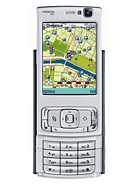
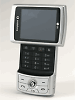
- glossy coating with mystical abstract design and a rotating screen which expose the keypads (see LG KU950 below)
* To enable more room for imagination and have a fantasy feel and is unique.
- SMS, MMS, Email, Instant Messaging
* A definite must have.
- Smooth-sounding MIDI ringtones, WMA/MP3/AAC/AAC+/eAAC+ player and Stereo FM Radio packaged with the phone.
* A music player in a phone for the audio pleasure.
- GPS Function, Organiser, Games, Walkie Talkie, Wi-Fi enabled, Office Document Viewer, Voice dial
* multi-functional phone to "wow" the crowd.
- Camera: autofocus, video(VGA 30fps), flash; secondary CIF videocall camera
* Camera with many functions.
- Build in handsfree
* To ease the usage of the phone.
- 3.5 mm audio output jack
* For enhancement of the audio system.
- TV out

* For enhancement of the video system.

Recommended phone would be the N95 in the phone specification aspects which is very functional and the LG Phonne, KU950 in which how the screen rotates to expose the keypads. Lastly, the phone can be a designer phone which features a abstract design and unique design.

After thought

I realise that User experience really differ from person to person and is a very subjective matter... For the 3 product I chose for my presentation for assignment 1, it seems that they do not wholly belong to the same category, but to me, it is the common study chair I used while at the study table..

But still I decided to replace the Product with the Behavioral Design with this, which I hope will make the 3 products appear to be in the same category: Leisure Chair


BEHAVORIAL DESIGN
A rotatable chair with armrest and a backing.
Behavorial: It is comfortable with a cushioned backing and enables one to orientate one's direction without moving the whole chair.
Visceral: It is just like any other chairs u see around, it do not particularly attracts one's attention.
Reflective: There is no show off value as the chair is simply not unique.

Sunday, January 27, 2008

Assignment 1: Products and emotion

This assignment actually proved as a challenge for me... Looking for a product is a challenge, looking for 3 similar products with similar yet different qualities... kinda profound ya...

So, after much deliberation, with a few products in mind, like DUSTBIN, BED and many many other electronic products, I finally decided on something that is more related to our daily life and is not IT based. THE CHAIR.

VISCERAL DESIGN
Visceral: It is a chair which gives people a first impression that it is sturdy, yet slender with a rather special support other then the normal 4 legged chair we see around.
Behavorial: Well, compared to a normal chair, it is too bulky and it tend to shake/rock more due to its unique design which can be a shock to unsuspecting people. (I will elaborate more during class but a simple explanation is that one can have a "falling" experience due to un-anticipated shakes/rocks.)
Reflective: Just a normal chair that we can find around, there is no show off value.


BEHAVORIAL DESIGN
A Roller chair, with wheels, armrest and a backing.
Behavorial: It is comfortable with an adjustable backing and has high "mobility". (One can slide across the room without standing up or rotates one's direction of sight without shifting the chair.)
Visceral: A very common roller chair that one can find around workplaces.
Reflective: As explained earlier, it is a rather common roller chair. (no show off value)


REFLECTIVE DESIGN
A chair with a "cool" design
Reflective: It is cool, trendy, brightly coloured and shaped in a manner normally one would not be able to see in a chair. One would view it more as a sculpture rather than a chair and the image it portray is one of modern and fashion, more popular with the young compared to the old.
Visceral: It is not like any normal chair you can see outside.
Behavorial: It yields a lot of different ways in which one can sit on the chair, but it is not very uncomfortable due to its contours which can be straining on one's back and the seat might be too low which might prove to be a hassle when used at a high desk or table.

(Different ways in which the chair can be used.)